Biography and artistic approach
Vanessa Yanow is a visual artist from Tiohtiá:ke/Mooniyang/Montreal. They work with digital embroidery, textile collage, artifacts, hot glass, drawing, and assemblage. Yanow enriches their intuitive and tactile artmaking practice with research whose diversity includes issues of queer sexualities and gender expressions, community care, female representation in the history of art and craft, climate change and parasitology. Vanessa has produced several large bodies of work and has exhibited nationally and internationally. Their sculptures are part of the city of Montreal’s permanent collection, the Musée des Métiers d’art du Québec, and Le Musée National des Beaux-Arts du Québec. They were the co-founder and coordinator of the non-profit organisation, The Long Haul – a 10 000 sq.ft studio and gallery space that was located in Parc Extension from 2001-2025. Vanessa is currently pursuing an MFA in Fibres and Material Practices at Concordia University.
***
My studio is a laboratory for experimentation, and my practice is led by play. I make collages, assemblages and sculptures with hand and machine-embroidered textiles, old clothes, family discards, natural and human-made found objects, wood, chain, hot glass and whatever else the work calls for. I intuitively combine matter that surprises and moves me.
The objects I make are reflective guides; they listen and gather fragments of my inner and outer life and shape them into forms I couldn’t have predicted. They feel both unfamiliar and anchored by my presence. My practice gives me space to sort through my life and to move between the material world and the pull of what lives beyond language.
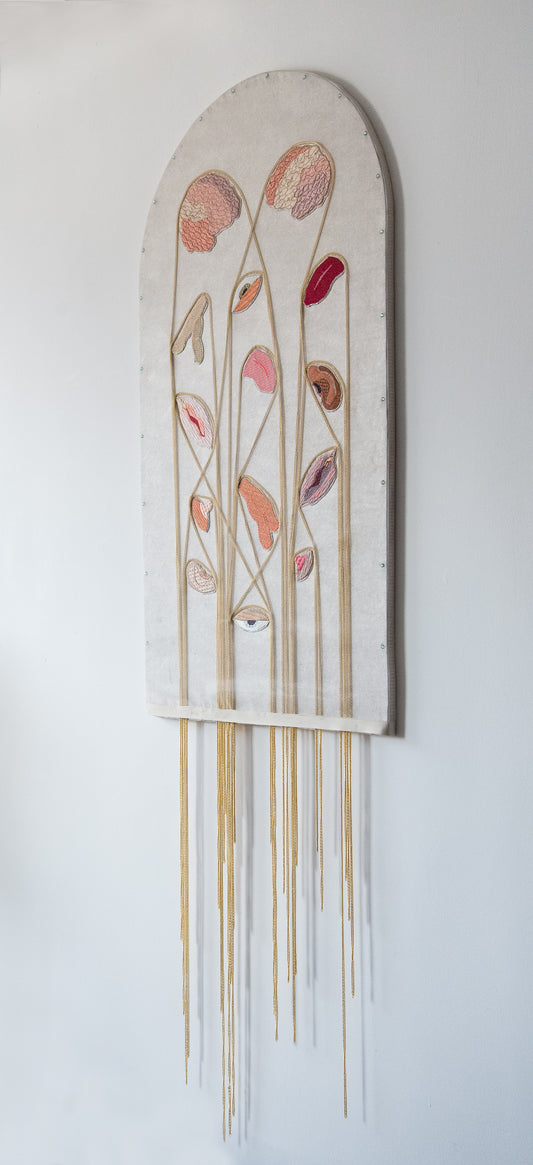
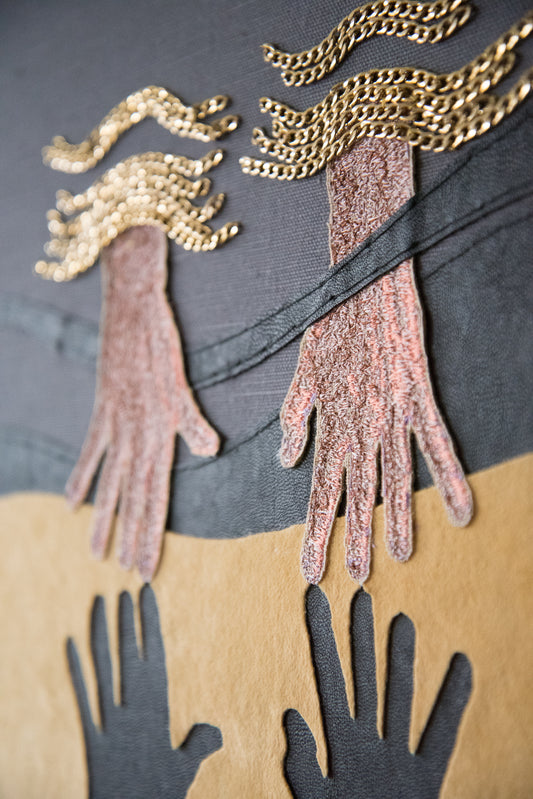
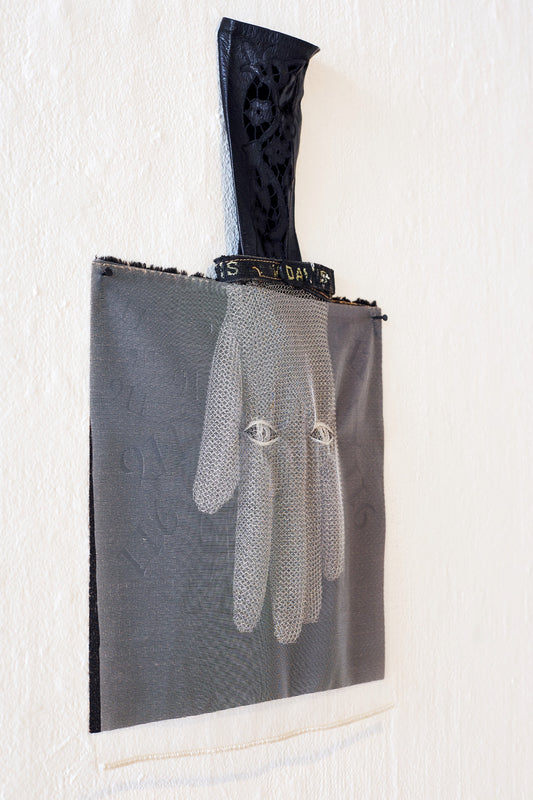
My work is an invitation to dwell with materiality while exploring how bodies, both human and more-than-human, take shape through the processes of transformation, vulnerability and care. Hands, sleeves and fragments of bodies are recurring symbols. Sleeves act as partial stand-ins for the body, they carry gestures, they reach, hold, and show absence. Detached from their original function, they become soft architectures, conduits for memory.
These works reject the idea of a single, stable identity and underline the porousness of the material world. In doing so, they articulate a refusal of fixed binaries: self and other, freedom and constraint, the grounded and the otherworldly.
I take pleasure in ornamenting my pieces as I would my kin - an act of care and exuberance that signals a shift from individualism toward an ethics of interconnection and shared vulnerability. Queer joy is always at the fore - it reframes care as expansive, communal, and resistant to oppression, where joy itself becomes a practice of survival, solidarity, and relational flourishing.
-
Holding Space
Regular price $2,800 CADRegular price -
Sapphic Sensitivities
Regular price $2,400 CADRegular price -
Passing Through Nature to Eternity.
Regular price $2,800 CADRegular price -
The Gauntlets CoDA
Regular price $880 CADRegular price